Moving to Decatur, Alabama? Here Are 5 Things Most Relocation Videos Won't Tell You
Most relocation videos about Decatur, Alabama follow the same script. Some river footage, a mention of Point Mallard, maybe a quick tour of downtown. What they leave out are the things that will actually shape your daily life once you move in — where to buy, how long your commute will take, and what you'll notice (or won't) depending on which part of the city you land in.
I'm Clint Peters, a REALTOR® with Real Broker. I've lived in North Alabama for nearly 50 years and helped over 100 families buy and sell in Decatur, Hartselle, Madison, Huntsville, Athens, and the surrounding area. The video above is the conversation I actually have with relocators before they start searching seriously. This post is the written version — same information, different format, because some people read before they watch.
Here is what most relocation videos skip.
1. Decatur Has an Industrial Side — and Sometimes You'll Know It
Let's get the elephant in the Tennessee River out of the way first.
Decatur is more industrial than most relocation content lets on. There's significant manufacturing along the river corridor, and two plants in particular — Meow Mix and Bunge — are what most locals reference when this topic comes up. If you've already spent time in the Facebook groups for Decatur, this probably isn't news to you.
The Smell Is Real, But It's a Geography Question
The smell is real. It's also not constant, and it's not everywhere.
Whether you notice it depends almost entirely on which part of Decatur you're in and which way the wind is blowing off the river on any given day. Some days, nothing at all. Other days, if you're in the northern part of the city closer to the industrial corridor, you might catch a few hours of it.
The areas that most relocators end up choosing — Southeast Decatur, the Point Mallard corridor, Burningtree, and Southwest — sit far enough from that corridor that many residents never think about it again after they move in. A year later, the families I've helped relocate to those areas aren't calling me about the smell. They're calling to send me their friends.
The short version: Where you buy in Decatur determines whether this is ever a real factor for you. It's a geography question, not a city question.
One more thing worth knowing: you won't see many riverfront homes for sale in Decatur. The river quarter here is industrial, and what isn't industrial is largely protected by TVA and the Wheeler Wildlife Refuge. That's a separate conversation — and probably a separate video — but it's worth knowing upfront if you're expecting a waterfront market here.
Here's the one that will change how you search.
Most relocators start the same way: open Zillow, draw a circle around Decatur, and start sorting by price. The problem is that subdivision names don't mean much to locals here. It can be genuinely hard to tell where one subdivision stops and another starts. What locals actually say is, "I live near Burningtree," or "I'm out in Southeast," or "We're in the Point Mallard area."
If you're searching by subdivision name, you're not searching the way the market actually works.
The Five Areas You Need to Know Before You Start Searching
Burningtree — Established area adjacent to Burningtree Country Club golf course. Mature trees, larger lots, tends to draw move-up buyers and families who want some space and a quieter feel. Close to I-65, which makes the commute to Huntsville straightforward.
Southeast Decatur — If I had to name one area where relocators end up most often, this is probably it. Close to shopping, medical facilities, and most of the neighborhoods feel established rather than brand new.
Point Mallard Area — Anchored by Point Mallard Water Park. Active families, nearby amenities, and it tends to hold value well over time.
Albany / Old Decatur / Historic District — Historic homes with character, walkable to downtown Decatur. You're trading newer construction for a home that has a story. It's not for everyone, but the people who love it genuinely love it.
Southwest Decatur — Feels newer. Sits close to the Beltline Corridor, which gives you straightforward access to shopping and dining without getting on the highway.
Before you start typing subdivision names into any search tool, figure out which area fits how you actually want to live day-to-day. That's the first conversation I have with every relocator on our first call.
3. Bridge Traffic Is Real — and It Will Affect Your Commute More Than You Think
If you're taking a job north of the river — Huntsville, Madison, Redstone Arsenal, Cummings Research Park — this one matters more than most relocation videos will ever mention.
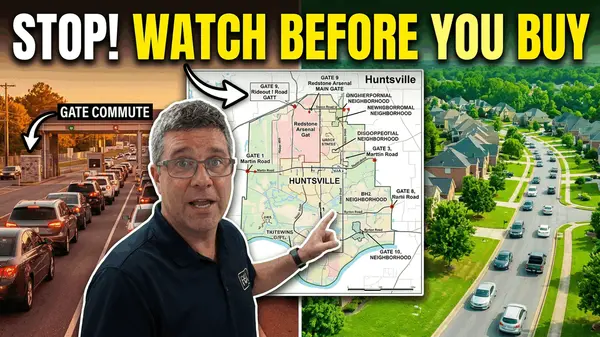
Getting between Decatur and Huntsville means crossing the Tennessee River. There are two main crossings: the Hudson Memorial Bridge in downtown Decatur, and the I-65 bridge a few miles east, closer to Priceville and Burningtree. During peak hours — especially southbound in the afternoon — both of those bridges can back up.
This isn't Atlanta-level traffic. It's not a reason not to move to Decatur. But it is something locals plan around, and newcomers often don't until they've already had a frustrating first month.
Here's what people who commute regularly learn pretty quickly: leave a little earlier (the 6:30–7:15 window tends to beat the worst of it), know which bridge to take depending on the day, and have an alternate route ready when there's an incident on one of them. A drive that takes 25 minutes at noon can run 45 minutes when rush hour stacks up.
The habit that saves you: Drive your actual commute at the actual time you'll be doing it before you commit to a specific part of town. That one test trip is worth more than any map app estimate.
4. The Affordability Gap Is Real — and It's the Reason Most Families Who Move Here Never Leave
Everything above is the honest accounting of Decatur's friction points. Here's the honest accounting of why I've stayed here nearly 50 years, and why the families I've helped relocate here aren't going anywhere.
Right now, what buys you a condo in parts of Madison or Huntsville can still get you a four-bedroom home with a yard in Decatur.
To put real numbers on it: the average price for approximately 2,500 square feet in Decatur right now is around $310,000. That same square footage runs roughly $386,000 in Huntsville and $423,000 in Madison. That's not a rounding difference. That's a meaningful gap in what your dollar actually buys.
Add lower property taxes on the Morgan County side of Decatur, and a pace of life that a lot of families are specifically looking for when they start researching North Alabama, and the math starts making a lot of sense.
I've watched this town for close to five decades. I've seen the manufacturing economy shift. I've seen downtown come back to life. I've seen families move here and then never leave — not because they can't, but because they don't want to. The ones who arrive with realistic expectations don't call me a year later asking how to get out. They call me to send me their friends.
That's the truth most relocation videos won't say out loud: Decatur isn't perfect. But for the right family — one looking for value, community, and access to Huntsville without Huntsville's price tag or traffic — it makes a lot of sense.
Frequently Asked Questions About Moving to Decatur, Alabama
Is Decatur, Alabama a good place to live? For families who value affordability, a slower pace, and access to a larger city without living in one, Decatur is a strong fit. Homes in the $300K range offer significantly more space than comparable budgets would buy in Huntsville or Madison. The city has an industrial side that affects some areas more than others, and bridge traffic is a real factor for anyone commuting north — but most residents who move here with realistic expectations end up staying.
How far is Decatur, Alabama from Huntsville? Decatur is roughly 25–30 miles from Huntsville, making it a manageable commute for families who work at Redstone Arsenal, Cummings Research Park, or elsewhere in the Huntsville metro. Peak-hour bridge traffic over the Tennessee River can push that drive closer to 40–45 minutes on busy afternoons, so commute timing matters.
What are the best areas in Decatur, Alabama? Locals think in areas rather than subdivision names. The five main areas are Burningtree, Southeast Decatur, the Point Mallard corridor, Albany/Old Decatur (the historic district), and Southwest Decatur. Each one fits a different lifestyle and price point. The right area depends on where you work, what you value in a neighborhood, and whether you want established character or newer construction.
Ready to Figure Out If Decatur Is the Right Fit?
If you want to run your numbers before you pick up the phone, start with the North Alabama Affordability Calculator — put in local home prices, your interest rate, and your target monthly payment, completely on your own timeline. No form submissions, no follow-up calls unless you want one.
If you want a deeper look at the neighborhoods, download the free Decatur Relocation Guide — it covers the specific areas above with more local detail than any Zillow filter will give you.
And if you're closer to ready and want to map out a timeline or talk through a specific area, book a 15-minute call. No pitch, no pressure — just a conversation.
Sincerely, Clint Peters REALTOR® | Real Broker 256.476.4201
Categories
Recent Posts